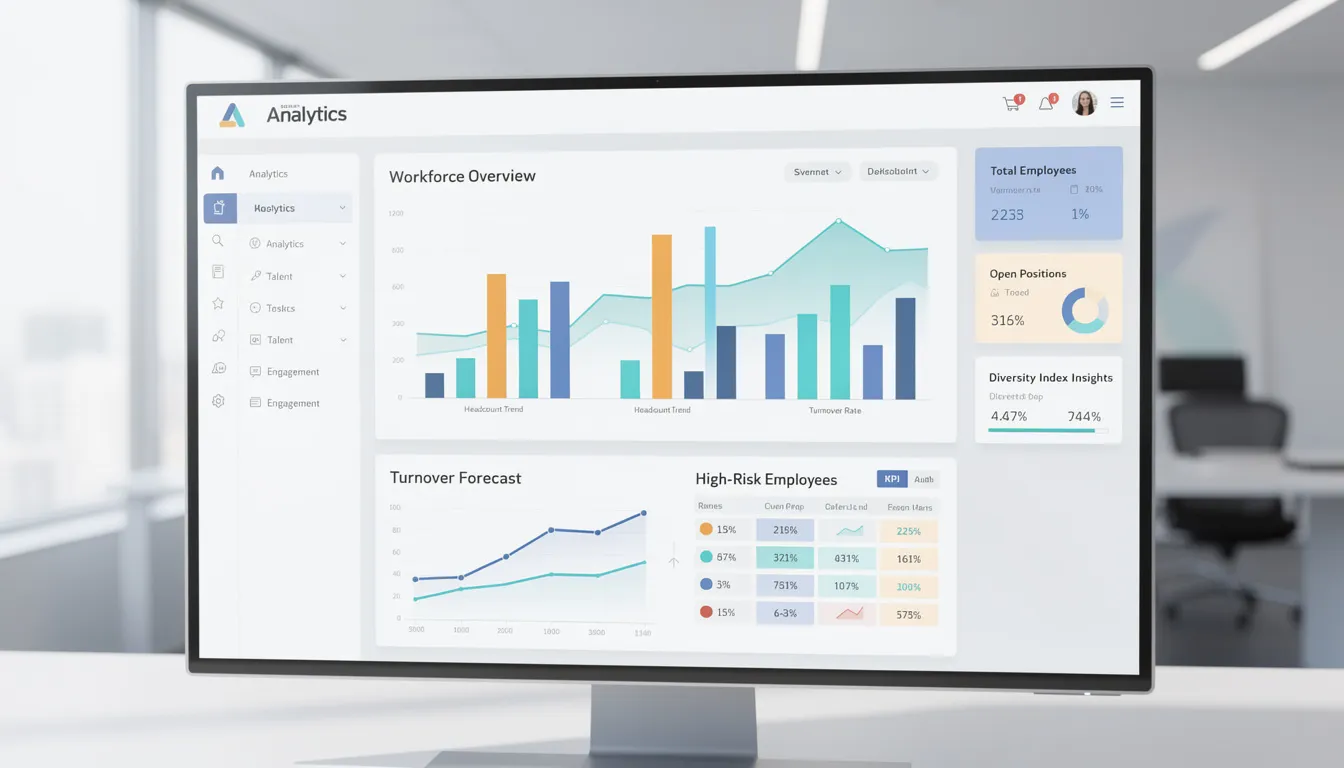
HR analytics platforms are fundamentally reshaping how Indian businesses manage their workforce in 2026, converting raw employee data into data driven insights that drive strategic decisions. The evolution from basic hr software in india to sophisticated workforce analytics solutions reflects a market projected to exceed $500 million in annual HR tech spending, with organizations leveraging advanced analytics to combat the 15-20% annual turnover rates plaguing sectors like IT and manufacturing.
This comprehensive review evaluates the leading hr analytics software available in India, focusing exclusively on platforms offering predictive capabilities, AI-powered workforce intelligence, and real-time reporting—excluding basic HRMS without advanced analytics depth. The target audience encompasses HR leaders, CHROs, business analysts, and C-suite executives in Indian companies seeking cloud based hr software that transforms hr data into competitive advantage.
Direct answer: The top hr analytics tools in India for 2026 include HROne, Darwinbox People Analytics, PeopleStrong Alt, Workday HCM, SAP SuccessFactors, Oracle HCM Cloud, Zoho People, Keka HR, GreytHR, BambooHR, and Factorial HR—each offering distinct strengths in predictive analytics, compliance management, and workforce intelligence tailored to different organizational scales.
By the end of this analysis, you will gain:
- Comprehensive platform comparison criteria with scoring methodology
- Implementation roadmap with realistic timelines for Indian deployments
- ROI calculation framework with documented cost savings
- Feature analysis covering analytics depth, statutory compliance, and seamless integration
- Vendor selection framework aligned with organizational maturity
Understanding HR Analytics Platforms
HR analytics platforms represent specialized analytics software solutions that transform raw workforce data into actionable insights, enabling hr professionals to move beyond intuition-based decisions toward evidence-driven talent management strategies. Unlike basic hr software focused primarily on payroll processing and attendance tracking, these platforms incorporate machine learning algorithms, predictive modeling, and real-time dashboards that surface patterns invisible to traditional reporting.
The relevance to the Indian market extends beyond operational efficiency. With compliance requirements under PF, ESI, and TDS regulations, plus the Code on Wages 2019 mandating pay equity analysis, Indian hr teams require platforms that simultaneously deliver advanced analytics while maintaining statutory compliance. The digital transformation initiatives accelerated by hybrid work models—now encompassing 40% of India’s organized workforce—demand workforce intelligence platform capabilities that basic hr management systems simply cannot provide.
Predictive Analytics Capabilities
Predictive HR analytics leverages machine learning to forecast workforce trends before they materialize, transforming hr operations from reactive to proactive. This encompasses predictive attrition scoring that analyzes historical patterns—tenure distribution, engagement survey responses, manager change frequency—to identify flight risks 3-6 months before resignation conversations occur.
The connection to strategic value is direct: organizations deploying predictive capabilities report 15-20% reduction in attrition costs, translating to ₹5-10 lakh savings per retained employee in knowledge-intensive sectors. For hr leaders navigating India’s competitive talent landscape, predictive models enable targeted retention interventions rather than blanket policies, optimizing limited HR budgets while delivering measurable business growth outcomes.
Real-time Workforce Intelligence
Real-time workforce intelligence extends beyond static reports, delivering dynamic dashboards that update as employee data changes across the entire employee lifecycle. Modern hr analytics tools process attendance management data, performance management scores, employee feedback, and compensation metrics simultaneously, surfacing correlations that quarterly reviews miss entirely.
This capability builds upon predictive analytics by creating a comprehensive analytics ecosystem: predictions identify where to look, while real-time intelligence reveals what’s happening now. For Indian businesses managing distributed workforces across multiple locations and time zones, cloud based hr solution platforms with real-time capabilities eliminate the reporting lag that historically delayed critical hr functions decisions. This foundation of understanding prepares us to evaluate specific platforms against these capability benchmarks.
Top 10 HR Analytics Platforms in India
Evaluating hr software options for the Indian market requires criteria beyond feature lists. Our methodology weighs analytics depth (35%), Indian compliance capabilities (25%), implementation complexity (15%), total cost of ownership (15%), and local support quality (10%)—reflecting the unique requirements human resources professionals face when selecting workforce analytics solutions for Indian operations.
Industry expert perspectives reinforce this evaluation approach. According to a senior CHRO quoted on G2, “The difference between Indian-native platforms and localized global solutions isn’t just compliance—it’s understanding how hr processes actually function in our regulatory and cultural context.” This sentiment echoes across review platforms, where user friendly interface ratings often diverge based on whether evaluators have Indian hr department experience.
Darwinbox People Analytics
Darwinbox leads enterprise analytics discussions for Indian unicorns and large enterprises, offering AI-powered insights that encompass predictive attrition models, diversity analytics, and employee engagement pulse surveys processed through machine learning algorithms. The platform’s mobile-first design supports geo-fencing for hybrid attendance management—a key features requirement for organizations managing remote workers across India.
Pricing: Custom enterprise pricing based on employee count and module selection; typical implementations range ₹200-500 per employee monthly for full-suite deployments.
Implementation timeline: 12-16 weeks for enterprise deployments with dedicated change management support.
User ratings: 4.2-4.3/5 across G2 and Capterra, with particular strength in analytics visualization and employee self service portal capabilities. Customer testimonials from Indian unicorns cite 25% improvement in engagement metrics following Darwinbox deployment, though smaller organizations report occasional bugs requiring support intervention.
PeopleStrong Alt Analytics
PeopleStrong’s workforce intelligence platform delivers advanced analytics tailored for large enterprises requiring custom reporting and deep integration with existing Indian payroll and compliance management systems. The platform excels at correlating performance management data with compensation outcomes, enabling talent management strategies grounded in quantitative evidence.
Key strengths: Real-time demographic filtering, automated compliance reporting for PF/ESI, and configurable dashboards serving both hr teams and business unit leaders seeking workforce productivity insights.
Integration: Strong connectivity with major Indian payroll processing systems, reducing data silos that typically plague enterprise hr systems implementations.
ROI documentation: Published case studies indicate 30% reduction in time-to-insight for workforce trends analysis, with large Indian corporations reporting ₹15-20 lakh annual savings in HR operations efficiency.
User ratings: 4.2/5 with consistent praise for analytics depth, though custom solution pricing creates evaluation complexity for procurement teams.
Workday HCM Analytics
Workday’s global platform brings substantial analytics firepower to Indian operations, with embedded skills gap analysis, succession planning modules, and performance correlation insights that connect individual employee performance to business outcomes. The platform’s strength lies in workforce planning scenarios—modeling reorganization impacts, hiring velocity requirements, and compensation structure changes before implementation.
Indian localization: Statutory compliance modules for TDS, PF, and ESI, though implementation requires more configuration than Indian-native platforms.
Ideal for: Multi-national corporations requiring consistent global analytics with Indian compliance overlay; organizations prioritizing succession planning and leadership development analytics.
Considerations: Implementation complexity and total cost of ownership exceed Indian alternatives, making Workday most appropriate for organizations where global standardization outweighs localization efficiency.
SAP SuccessFactors Workforce Analytics
SAP SuccessFactors delivers enterprise-grade analytics with comprehensive talent intelligence, workforce benchmarking against industry standards, and multi-location analysis capabilities essential for businesses operating across Indian states with varying labor regulations. The platform’s embedded analytics connect learning management data with career progression outcomes, supporting talent acquisition and development strategies.
Compliance reporting: Strong Indian statutory compliance with automated reporting workflows reducing manual effort for hr department teams.
Benchmarking: Access to aggregated workforce trends data enables comparison against industry peers—particularly valuable for compensation analysis and attrition rate contextualization.
User ratings: 4.0-4.2/5, with enterprise users praising depth while medium sized businesses report complexity exceeding their requirements.
Oracle HCM Cloud Analytics
Oracle’s analytics suite embeds AI and machine learning throughout workforce optimization workflows, from employee lifecycle management prediction to automated payroll processing optimization. The platform’s strength in data management supports organizations requiring sophisticated workforce data governance alongside analytics capabilities.
Advanced features: Skills ontology mapping, internal mobility prediction, and workforce planning scenarios incorporating external labor market data.
Indian market considerations: Enterprise pricing and implementation investment suit large enterprises with dedicated HR technology teams; small and medium businesses typically find Oracle’s complexity-to-value ratio unfavorable.
Cost analysis: Expect ₹300-600 per employee monthly for comprehensive analytics modules, with 16-24 week implementation timelines for Indian deployments.
Zoho People Analytics
Zoho People offers an SME-focused analytics platform with affordable pricing and ease of use that makes advanced analytics accessible to small businesses lacking dedicated analytics resources. The platform’s custom dashboard creation capabilities enable hr professionals to build reports aligned with specific organizational questions rather than conforming to pre-built templates.
Pricing: Starting at ₹72/user/month, making it among the most accessible top hr software options for analytics capabilities.
Strengths: Seamless integration with the broader Zoho ecosystem (CRM, Finance, Projects), employee self service functionality, and leave management analytics that surface absence patterns affecting workforce productivity.
Limitations: Analytics depth falls short of enterprise platforms; organizations requiring predictive attrition modeling or sophisticated machine learning applications may outgrow Zoho’s capabilities.
User ratings: 4.5/5 for scalability and ecosystem integration, with criticism focused on clunky payroll interfaces and absence of 24/7 support.
Keka Analytics Dashboard
Keka HR represents Indian-built best hr software with deep local compliance understanding and regional workforce insights that global platforms often miss. The platform’s analytics dashboard serves startups and mid-market organizations requiring core hr functions plus actionable insights without enterprise complexity.
Pricing: ₹6,999/month for 100 users (approximately ₹49/user monthly), positioning Keka as highly competitive for small and medium businesses.
Compliance strength: 90% automation of statutory compliance reporting, with built-in PF, ESI, and TDS calculations reducing manual intervention.
Analytics capabilities: Intuitive visualizations covering attrition trends, employee engagement metrics, and performance management analytics; described as basic compared to enterprise tools but substantially exceeding pure-play HRMS offerings.
User ratings: 4.4-4.6/5 across review platforms, with particular praise for mobile access and statutory compliance handling. Support responsiveness generates mixed feedback.
GreytHR Analytics Module
GreytHR, one of India’s oldest indian hr software platforms since 2010, prioritizes reliability in payroll software, PF/ESI compliance, and attendance management analytics for SMEs. The analytics module provides comprehensive reporting and trend analysis that surfaces patterns in employee life cycle metrics, though without the predictive depth of newer AI-focused competitors.
Pricing: ₹25/employee/month, delivering exceptional value for organizations prioritizing compliance and operational analytics.
Strengths: Quick setup (often under 2 weeks), dependable payroll automation, and integration with attendance tracking for complete workforce picture.
Analytics depth: Focus on descriptive analytics—what happened—rather than predictive modeling. Case studies document 30% reduction in compliance errors for manufacturing firms, demonstrating operational value even without advanced analytics.
Ideal for: Traditional industries (manufacturing, retail, hospitality) where compliance management and operational efficiency outweigh predictive analytics requirements.
BambooHR Reporting and Analytics
BambooHR brings user friendly interface excellence to HR analytics, with customizable reports and employee lifecycle insights that make data accessible to hr professionals without technical backgrounds. The platform’s strength in employee experience analytics—satisfaction surveys, onboarding effectiveness, exit interview analysis—complements operational metrics.
International platform: US-headquartered with Indian customer success stories, though statutory compliance requires additional configuration compared to Indian-native alternatives.
Analytics approach: Focus on employee satisfaction and boost employee satisfaction outcomes through actionable employee feedback analysis and engagement tracking.
Ideal for: Indian subsidiaries of multinational corporations seeking consistent global platforms, or Indian startups with international expansion plans requiring systems that scale across geographies.
Factorial HR Analytics
Factorial delivers modern analytics with mobile-first approach and AI-powered recommendations that appeal to organizations prioritizing modern hr software aesthetics alongside functionality. The platform’s rapid deployment model—often under 4 weeks to go-live—suits businesses requiring quick analytics activation.
Competitive positioning: Affordable pricing combined with contemporary UX positions Factorial against traditional Indian platforms that prioritize functionality over experience.
AI capabilities: Embedded recommendations for hr tasks optimization, though machine learning depth doesn’t match dedicated enterprise analytics platforms.
Indian market traction: Growing adoption among technology startups and digital-native businesses, with user ratings around 4.3/5 and consistent praise for implementation speed.
Platform Selection and Implementation Framework
Transforming platform knowledge into selection decisions requires systematic evaluation beyond feature comparison. The following framework integrates analytics capabilities, operational requirements, and organizational constraints into actionable selection methodology.
Evaluation Criteria and Scoring Matrix
Systematic platform comparison enables objective vendor assessment that transcends sales presentation influence. Weight each criterion according to organizational priorities, then score candidates on a 1-5 scale.
| Criterion | Weight | Darwinbox | PeopleStrong | Workday | SAP | Oracle | Zoho | Keka | GreytHR | BambooHR | Factorial |
|---|---|---|---|---|---|---|---|---|---|---|---|
| Analytics Depth | 35% | 5 | 5 | 5 | 5 | 5 | 3 | 3 | 2 | 3 | 3 |
| Indian Compliance | 25% | 5 | 5 | 3 | 4 | 3 | 4 | 5 | 5 | 2 | 3 |
| Implementation Ease | 15% | 3 | 3 | 2 | 2 | 2 | 4 | 4 | 5 | 4 | 5 |
| Total Cost | 15% | 2 | 2 | 1 | 2 | 1 | 5 | 5 | 5 | 3 | 4 |
| Local Support | 10% | 5 | 5 | 3 | 3 | 3 | 3 | 4 | 5 | 2 | 3 |
Interpretation: Large enterprises prioritizing analytics depth accept higher costs and implementation complexity (Darwinbox, PeopleStrong, global suites). Small and medium businesses optimize for compliance and cost (Keka, GreytHR, Zoho), accepting analytics limitations. Organizations fall along this spectrum based on scale, maturity, and strategic HR priorities.
Implementation Roadmap
Successful deployment follows predictable phases regardless of platform selection:
- Requirements documentation (Weeks 1-3): Catalog existing hr processes, data sources, integration requirements, and stakeholder analytics needs before vendor discussions.
- Vendor evaluation and selection (Weeks 4-8): Conduct structured demonstrations against documented requirements; involve both hr teams and IT stakeholders in scoring.
- Data preparation (Weeks 9-12): Cleanse historical workforce data, establish data governance protocols, and configure integration connections with existing hr systems.
- Pilot deployment (Weeks 13-16): Launch with limited user group (typically single business unit), gather feedback, and iterate configuration before broad rollout.
- Organization-wide rollout (Weeks 17-20): Phased activation with dedicated change management and training support.
- Optimization (Ongoing): Monthly review of analytics utilization, quarterly capability expansion, and annual strategic alignment assessment.
Timeline expectations: Indian-native platforms (Keka, GreytHR) typically complete implementation in 4-8 weeks. Enterprise platforms (Darwinbox, PeopleStrong) require 12-16 weeks. Global suites (Workday, SAP, Oracle) often extend to 20-24 weeks due to compliance configuration complexity.
ROI Calculation Framework
Quantifying analytics platform returns requires both cost documentation and value measurement.
Implementation costs:
- Platform licensing: ₹25-600/employee monthly depending on platform and modules
- Implementation services: ₹50,000-5,00,000 for configuration and data migration
- Training: ₹2,000-5,000 per hr department user
- Ongoing support: Typically 15-20% of annual licensing
Projected value streams:
- Attrition reduction: 15-20% decrease through predictive intervention = ₹5-10 lakh savings per retained employee
- HR operations efficiency: 30-50% faster decision-making through dashboards = 25-40 hours monthly per HR analyst
- Compliance automation: 90% reduction in manual compliance effort = ₹50,000-2,00,000 annual savings for mid-sized organizations
- Performance optimization: 10-15% improvement in workforce productivity through data driven insights
ROI timeline: Most organizations achieve positive ROI within 12-18 months, with analytics platforms typically generating 3-5x return over 3-year deployment periods.
Common Implementation Challenges and Solutions
Indian organizations deploying hr analytics tools encounter predictable obstacles. Proactive planning transforms these challenges from project risks into manageable tasks.
Data Integration and Quality Issues
The most common implementation barrier involves connecting disparate hr systems while ensuring employee data accuracy. Many Indian organizations operate fragmented technology environments—separate systems for payroll management, attendance management, performance management, and talent acquisition—with inconsistent data formats and employee identifiers.
Solution approach: Establish master data management protocols before implementation. Create golden record definitions for employee identity, standardize date formats and coding schemes, and implement data quality scoring that flags anomalies. Invest in dedicated data cleansing sprint (typically 2-4 weeks) rather than attempting cleanup during platform configuration.
User Adoption and Training Resistance
Technology deployment succeeds or fails based on user adoption. Human resources professionals accustomed to intuition-based decisions may resist analytics-driven approaches, perceiving platforms as threatening rather than enabling.
Actionable strategies: Begin with quick wins—dashboards that answer questions users already ask. Train hr teams on interpretation rather than just navigation. Celebrate decisions improved through data driven insights. Establish analytics champions within each business unit who model effective utilization.
Success metrics: Track monthly active users, dashboard access frequency, and decision attribution to analytics insights. Target 80% monthly active usage within 6 months post-launch.
Compliance and Data Privacy Concerns
The Digital Personal Data Protection Act 2023 creates compliance requirements for employee data processing that analytics platforms must address. Organizations face legitimate concerns about data security, access controls, and audit trail maintenance.
Solutions: Select platforms with robust security certifications (ISO 27001, SOC 2). Implement role-based access limiting employee data visibility to authorized personnel. Configure audit trails documenting who accessed what data when. Establish data retention policies aligned with legal requirements and organizational risk tolerance.
Conclusion and Strategic Next Steps
The right hr software transforms workforce data from administrative byproduct into strategic asset, enabling Indian organizations to predict challenges, optimize investments, and build competitive advantage through superior talent management. Whether selecting enterprise platforms like Darwinbox for sophisticated predictive analytics or choosing solutions like Keka and GreytHR for compliance-focused efficiency, the key lies in matching platform capabilities to organizational maturity and strategic priorities.
Immediate action steps:
- Conduct needs assessment: Document current hr analytics capabilities, gaps, and strategic requirements over the next 3 years
- Request vendor demonstrations: Schedule structured evaluations with 3-5 shortlisted platforms, involving both HR and IT stakeholders
- Plan pilot program: Identify business unit suitable for controlled deployment before organization-wide rollout
- Establish success metrics: Define specific outcomes (attrition reduction percentage, time-to-insight improvement, user adoption rates) before implementation
Organizations seeking deeper exploration may consider related topics: HR digital transformation strategies, workforce data governance frameworks, and emerging AI applications in talent acquisition. Each topic extends the foundation established through analytics platform selection into broader organizational capability development.
Additional Resources
Vendor evaluation tools:
- Platform comparison checklist aligned with evaluation criteria above
- RFP template incorporating Indian compliance and analytics requirements
- Demo scoring rubric for structured vendor assessment
Platform access:
- Request trial versions through vendor websites for hands-on evaluation
- Schedule customized demonstrations addressing specific organizational requirements
Industry resources:
- HR technology benchmarking reports from industry associations
- Published case studies documenting Indian implementation outcomes
- Professional HR analytics certification programs for capability development
Disclaimer: Rankings and ratings reflect May 2025 data from G2, Capterra, and vendor sources. Platform capabilities and pricing evolve continuously; verify current offerings through direct vendor engagement. Test demos with your specific requirements before procurement decisions.