
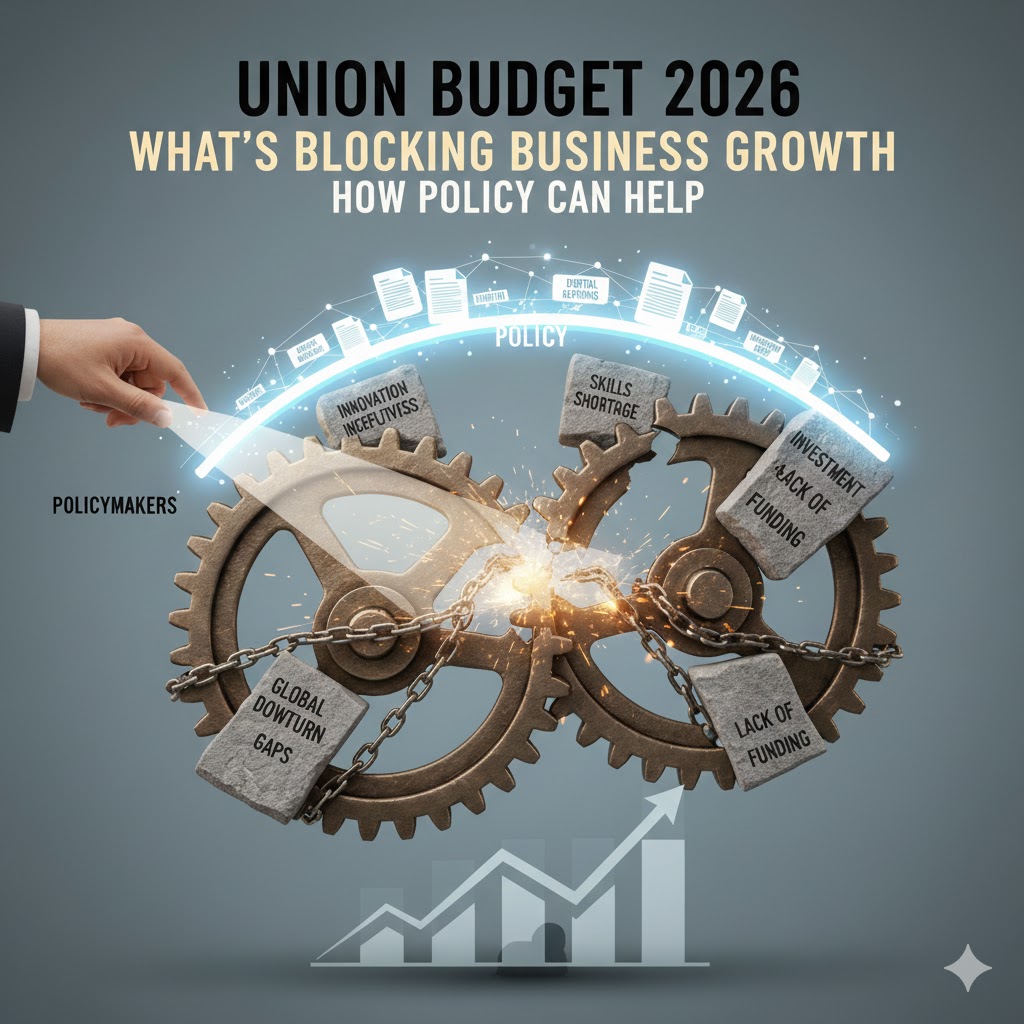
India’s businesses face concrete obstacles that slow expansion and limit job creation. The Union Budget 2026 presents an opportunity to address structural issues holding back growth across sectors.
The Core Problems
Access to Capital
Small and medium enterprises struggle to secure affordable financing. Banks reject 40% of loan applications from businesses with less than five years of operations. High interest rates of 11-14% make borrowing expensive compared to developed markets where rates sit at 4-6%.
Your business needs capital to expand, hire people, and invest in technology. Current lending practices favor established companies with extensive collateral.
Compliance Burden
Business owners spend 200-250 hours per year on tax compliance alone. Add labor regulations, environmental clearances, and industry-specific permits. This administrative load divides time and resources away from core operations.
The Goods and Services Tax system requires multiple returns. State and central regulations often overlap. Your team handles paperwork instead of serving customers.
Infrastructure Gaps
Logistics costs consume 13-14% of GDP in India versus 8% in developed economies. Poor road connectivity, inadequate warehousing, and congested ports slow supply chains.
Moving goods from factory to market takes longer and costs more than competitors abroad. Your margins suffer because infrastructure lags behind demand.
Skilled Labor Shortage
India produces 1.5 million engineering graduates annually. Yet companies report difficulty finding employees with practical skills. The gap between academic training and workplace requirements widens each year.
You hire fresh graduates and invest months in training. This delays productivity and raises costs.
Tax Uncertainty
Retrospective taxation and frequent policy changes create planning difficulties. Businesses need predictable tax treatment to make long-term investment decisions.
When rules change mid-year, your financial projections become unreliable. Uncertainty pushes capital toward safer, less productive uses.
Policy Solutions That Work
Reform Credit Access
The government should expand the Credit Guarantee Fund Trust for Micro and Small Enterprises. Increase the corpus from Rs 25,000 crore to Rs 75,000 crore. This allows banks to lend with reduced risk.
Introduce interest rate subsidies of 2-3% for first-time borrowers under 35 years. Young entrepreneurs need better terms to compete.
Direct the Reserve Bank of India to mandate priority sector lending quotas specifically for businesses less than three years old. New ventures create the most jobs but face the highest rejection rates.
Simplify Compliance
Consolidate all tax filings into one quarterly return. Combine GST, income tax, and TDS into a single submission. Technology exists to automate most reporting.
Create a unified portal for all business registrations and licenses. Currently, you navigate separate systems for central, state, and local approvals. One platform cuts processing time by 60-70%.
Reduce GST slabs from four to two: 5% for essentials and 18% for other goods. Fewer rates mean less confusion and lower compliance costs.
Build Infrastructure Faster
Allocate Rs 15 lakh crore over three years for dedicated freight corridors and last-mile connectivity. Focus on tier-2 and tier-3 cities where industrial growth concentrates.
Offer tax breaks to private companies building warehouses in underserved regions. Logistics providers need incentives to expand beyond metros.
Fast-track port modernization with 24-hour operations at major terminals. Reducing dwell time from 3 days to 1 day saves exporters significant costs.
Bridge the Skills Gap
Mandate that engineering and commerce colleges dedicate 30% of curriculum to hands-on projects with industry partners. Students learn by solving real problems.
Create tax deductions for businesses spending on employee training programs. Allow 150% deduction on training expenses up to Rs 10 lakh per year per company.
Establish national apprenticeship standards with wage subsidies covering 50% of intern costs for six months. This encourages companies to hire and train entry-level workers.
Stabilize Tax Policy
Commit to a five-year freeze on major tax law changes. Businesses need time to adapt and plan investments.
Abolish all retrospective tax provisions. Grandfather existing disputes with a one-time settlement at 50% of demand. This clears pending cases and restores investor confidence.
Reduce corporate tax to 20% for companies reinvesting 60% or more of profits into expansion. Reward growth-oriented behavior with lower rates.
Sector-Specific Actions
Manufacturing
Extend Production Linked Incentive schemes to 15 additional sectors including auto components, industrial machinery, and consumer durables. Current coverage reaches only 14 sectors.
Lower import duties on raw materials and capital goods to 5%. High input costs make Indian manufacturers less competitive globally.
Services
Allow 100% foreign direct investment in professional services like law, accounting, and architecture. Opening these sectors attracts global firms and raises service standards.
Remove restrictions on hiring foreign specialists for technology and consulting projects. Expertise gaps limit project execution.
Agriculture and Food Processing
Provide Rs 1 lakh crore in low-interest loans for cold storage and processing facilities near production areas. Post-harvest losses exceed 30% for perishables.
Permit private sector participation in procurement and storage of food grains. Government monopolies create bottlenecks.
Retail and E-commerce
Clarify FDI rules for online marketplaces. Current ambiguity deters investment and limits growth.
Reduce GST on logistics and warehousing services from 18% to 5%. Lower costs benefit sellers and buyers.
Implementation Matters
Policy announcements mean little without execution. The budget should specify timelines, responsible agencies, and measurable targets.
Set up an implementation tracking dashboard updated monthly. Transparency shows progress and identifies delays early.
Conduct quarterly reviews with industry representatives. Feedback loops help adjust policies based on ground realities.
The Economic Case
Removing growth barriers adds 1-2 percentage points to GDP growth over three years. Higher growth generates tax revenue that offsets the cost of reforms.
Each percentage point of GDP growth creates approximately 2 million jobs across sectors. Employment remains the most pressing social need.
Better business conditions attract foreign investment. India receives $60-70 billion in FDI annually. Reforms could push this to $100 billion within two years.
What Businesses Should Do
While waiting for policy changes, optimize operations within current constraints.
Explore alternative financing through venture debt, invoice discounting, and supply chain finance. Traditional bank loans are not the only option.
Invest in compliance automation software. Technology reduces manual effort and error rates.
Partner with skill development organizations to build your own training pipelines. Don’t wait for education reform.
Collaborate with logistics providers on shared warehousing and transportation. Collective solutions lower individual costs.
The Path Forward
The Union Budget 2026 arrives at a critical moment. Global economic conditions remain uncertain. Domestic consumption shows mixed signals. Businesses need policy support to navigate challenges and seize opportunities.
Finance Minister Nirmala Sitharaman has acknowledged these concerns in recent speeches. The budget must translate intent into specific measures with adequate funding.
Your business growth depends partly on what you control and partly on the environment you operate in. Policy shapes that environment. The budget determines whether India creates conditions for businesses to thrive or continues with incremental adjustments that preserve the status quo.
Growth requires removing friction from business operations. The budget provides the means to do this. Whether the government acts decisively will become clear on February 1, 2026.