
Indian businesses generated over 50 petabytes of data in 2025, yet fewer than 40% leverage data analytics software to transform this raw data into actionable insights. Selecting the right data analytics tools determines whether your organization makes data-driven decisions or drowns in unused information. This comprehensive review examines the top 10 data analytics platforms available in India, evaluating each for features, Indian market pricing, local support, and real-world performance.
This guide covers enterprise and SME-focused analytics software with established presence in India, including pricing in INR, implementation requirements, and vendor support considerations. Content focuses on business intelligence, data visualization, and predictive analytics platforms—excluding niche data science tools requiring extensive programming expertise.
Direct Answer: The top 10 data analytics software in India for 2026 are Microsoft Power BI, Tableau, QlikView/Qlik Sense, SAS Analytics, IBM Cognos Analytics, Oracle Analytics Cloud, Zoho Analytics, Sisense, Alteryx, and TIBCO Spotfire. Power BI leads for SMEs with pricing starting at ₹844/user/month, while Zoho Analytics offers the best value for Indian startups with plans from ₹1,740/month.
Key outcomes from this guide:
- Understanding key features and pricing structures for each platform in Indian context
- Evaluating local support availability and regional language capabilities
- Calculating ROI expectations for different business sizes
- Identifying compliance requirements under Indian data protection regulations
- Matching software capabilities to specific industry requirements
Understanding Data Analytics Software Landscape in India
Data analytics software encompasses tools for data integration, data visualization, statistical analysis, and machine learning—enabling organizations to analyze data and extract valuable insights from complex datasets. In India’s rapidly digitizing economy, these platforms have become essential infrastructure for business performance optimization across IT services, manufacturing, healthcare, and financial sectors.
The demand surge stems from Digital India initiatives, exploding data volumes from UPI transactions exceeding 10 billion monthly, and intensifying competition requiring real-time analytics capabilities. Organizations across sectors now require sophisticated data analysis tools to maintain competitive advantage.
Market Dynamics and Growth in Indian Analytics Sector
India’s analytics market has expanded from $1 billion in 2015 to over $10 billion by 2025, with projections reaching $16 billion by 2026—a 40% compound annual growth rate in generative analytics adoption. Enterprise adoption rates now exceed 75% for AI-powered analytics tools among large corporations.
Government initiatives supporting data-driven decision making include the Digital India programme, Smart Cities Mission requiring urban analytics infrastructure, and mandatory GST compliance generating massive structured datasets. The National Data Governance Framework further accelerates cloud-based data warehouse adoption across public sector organizations.
Industry adoption patterns reveal banking and financial services leading with 45% analytics penetration, followed by e-commerce at 38%, telecommunications at 35%, and manufacturing at 28%. This growth creates 2 million analytics jobs projected by 2026 according to Nasscom projections.
Key Requirements for Indian Businesses
Multi-language support remains critical for organizations operating across India’s diverse linguistic landscape. Approximately 20% of analytics tools now offer Hindi and regional language interfaces, with demand growing for Marathi, Tamil, Telugu, and Bengali reporting capabilities for non-technical users.
Cost-effectiveness determines adoption for India’s 63 million SMEs operating on constrained budgets. Cloud-based deployments offering pay-per-use models typically deliver 30-50% cost savings compared to on-premises installations, making advanced analytics accessible to smaller organizations.
Integration capabilities with existing ERP systems—particularly Tally, SAP, and Oracle implementations common in Indian enterprises—determine implementation success. Seamless integration with domestic payment systems, GST portals, and banking APIs adds critical functionality for Indian operations.
Selection Criteria for Data Analytics Software in India
Evaluating data analytics platforms requires systematic assessment across multiple dimensions specific to Indian business environments. Beyond feature comparisons, organizations must consider total ownership costs, vendor stability, and regulatory compliance.
Budget and Total Cost of Ownership
Pricing models in India typically follow three structures: perpetual licensing (one-time purchase plus annual maintenance), subscription (monthly/annual per-user fees), and consumption-based (pay-per-query or storage). Subscription models increasingly dominate, offering predictable expenses and automatic updates.
Hidden costs frequently exceed initial licensing fees:
- Implementation services: ₹5-50 lakhs depending on complexity
- Training programs: ₹50,000-5 lakhs per team
- Data preparation and cleaning: Often 60-80% of initial project timeline
- Infrastructure upgrades: Server capacity, network bandwidth improvements
- Ongoing support contracts: 15-22% of license value annually
ROI calculation in Indian contexts typically shows 5x returns within 18-24 months for properly implemented analytics, with specific gains including 25-30% reduction in inventory costs, 15-20% improvement in customer retention, and 40% faster reporting cycles.
Local Support and Vendor Presence
Indian offices, local partnerships, and IST-aligned customer support significantly impact implementation success. Organizations report 20-30% faster issue resolution with vendors maintaining dedicated Indian support centers versus those relying on international teams.
Critical support considerations include:
- Presence in major business centers: Mumbai, Bangalore, Delhi-NCR, Chennai, Hyderabad
- Hindi and English documentation availability
- Local certified consultants for implementation and customization
- Training centers offering in-person instruction
- Partner ecosystem for industry-specific implementations
Compliance and Security Requirements
The Digital Personal Data Protection Act 2023 mandates specific data handling practices affecting analytics software selection. Key requirements include data localization for sensitive personal information, consent management capabilities, and audit trail maintenance.
Security certifications required for Indian government and enterprise clients include ISO 27001, SOC 2 Type II, and sector-specific standards like RBI guidelines for banking analytics. Cloud deployments must maintain data residency options within Indian borders for regulated industries.
Top 10 Data Analytics Software Solutions Available in India
The following evaluations incorporate G2 global rankings, Indian market adoption data, and expert assessments from industry analysts. Each platform assessment includes real-time analytics capabilities, data visualization strengths, and suitability for different organizational scales.
Microsoft Power BI
Features: Power BI delivers comprehensive business intelligence with drag-and-drop data visualization, AI-powered insights, natural language querying, and real-time analytics dashboards. Azure integration enables advanced analytics on large datasets without infrastructure investments.
Indian Pricing: Pro tier at ₹844/user/month; Premium Per User at ₹1,688/user/month; Premium capacity starting at ₹4,22,045/month for enterprise deployments. Educational discounts available through Microsoft Imagine Academy partnerships.
Local Presence: Microsoft India maintains offices in 9 cities with extensive partner networks exceeding 10,000 certified professionals. Hindi language support available in interface and documentation. Strong integration with India-specific data sources including GST portals.
Best Suited For: Organizations with existing Microsoft 365 investments seeking interactive dashboards and self-service analytics. Dominant among Indian SMBs with approximately 60% market share in this segment.
Expert Review: According to G2 reviews (4.5/5 from 10,000+ users), Power BI excels at accessibility for non-technical users while maintaining depth for data analysts. An Indian CTO quoted on G2 noted: “Power BI transformed our operations—we reduced report generation from 3 days to 3 hours.” Limitations include restricted advanced machine learning without Premium tier and occasional performance issues with datasets exceeding 10 million rows.
Tableau
Features: Tableau provides advanced data visualization through intuitive interfaces, enabling visual data exploration without coding. The Hyper engine delivers hyper-fast rendering on big data, while VizQL technology translates drag-and-drop actions into optimized queries.
Indian Market Presence: Salesforce India operations support Tableau through Mumbai and Bangalore offices. Local training centers offer certification programs, with approximately 15,000 certified Tableau professionals in India.
Pricing Structure: Creator license at approximately ₹5,900/user/month; Explorer at ₹3,500/user/month; Viewer at ₹1,250/user/month. Volume discounts available for enterprise deployments.
Customer Base: Major Indian corporations including HDFC Bank, Flipkart, and Bharti Airtel utilize Tableau for data visualization techniques. Fractal Analytics integrates Tableau with their DI platform serving Fortune 500 clients.
Expert Assessment: Industry analysts praise Tableau’s visualization capabilities while noting the learning curve for complex analytical workflows. Mu Sigma leverages Tableau for supply chain optimization, achieving 30% efficiency improvements for e-commerce clients. Primary limitation remains premium pricing unsuitable for budget-constrained SMEs.
QlikView/Qlik Sense
Features: The associative data model enables exploratory data analysis through dynamic associations across datasets—users discover relationships invisible in traditional query-based tools. Qlik Sense offers modern self-service capabilities while QlikView serves enterprise reporting needs.
Indian Implementation: Local partners in Mumbai, Delhi, Bangalore, Chennai, and Hyderabad provide implementation services. Training programs through authorized centers and online platforms support skill development.
Cost Considerations: Enterprise licensing typically ranges ₹3,000-6,000/user/month depending on capabilities. Implementation costs average ₹15-40 lakhs for mid-sized deployments.
Industry Adoption: Manufacturing, retail, and financial services sectors demonstrate strongest adoption. Genpact utilizes Qlik for risk management analytics supporting global banking clients.
Professional Review: Qlik’s associative approach receives praise from data scientists requiring flexible data exploration without predetermined query paths. G2 ratings average 4.2/5, with users highlighting intuitive discovery capabilities. Challenges include steeper learning curve compared to Power BI and higher memory requirements for large datasets.
SAS Analytics
Features: SAS delivers advanced analytics, statistical computing, and machine learning capabilities for complex data science projects. Comprehensive data manipulation, predictive modeling, and prescriptive analytics address enterprise-scale requirements.
SAS India Presence: Major development centers in Pune and Hyderabad support global product development. Extensive corporate training programs through SAS Academy, with strong university partnerships providing talent pipeline.
Enterprise Pricing: High-end solution with enterprise licenses typically exceeding ₹10 lakhs annually. Cloud-based SAS Viya offers more flexible consumption pricing.
Sector Focus: Banking institutions (40% of India’s top 100 banks use SAS for regulatory reporting), pharmaceutical companies for clinical trial analytics, and government statistical agencies represent primary user segments.
Expert Evaluation: Industry analysts consider SAS the gold standard for statistical analysis and advanced features requiring rigorous validation. Limitations include premium pricing restricting access to large enterprises and steeper learning curve for business users versus data scientists.
IBM Cognos Analytics
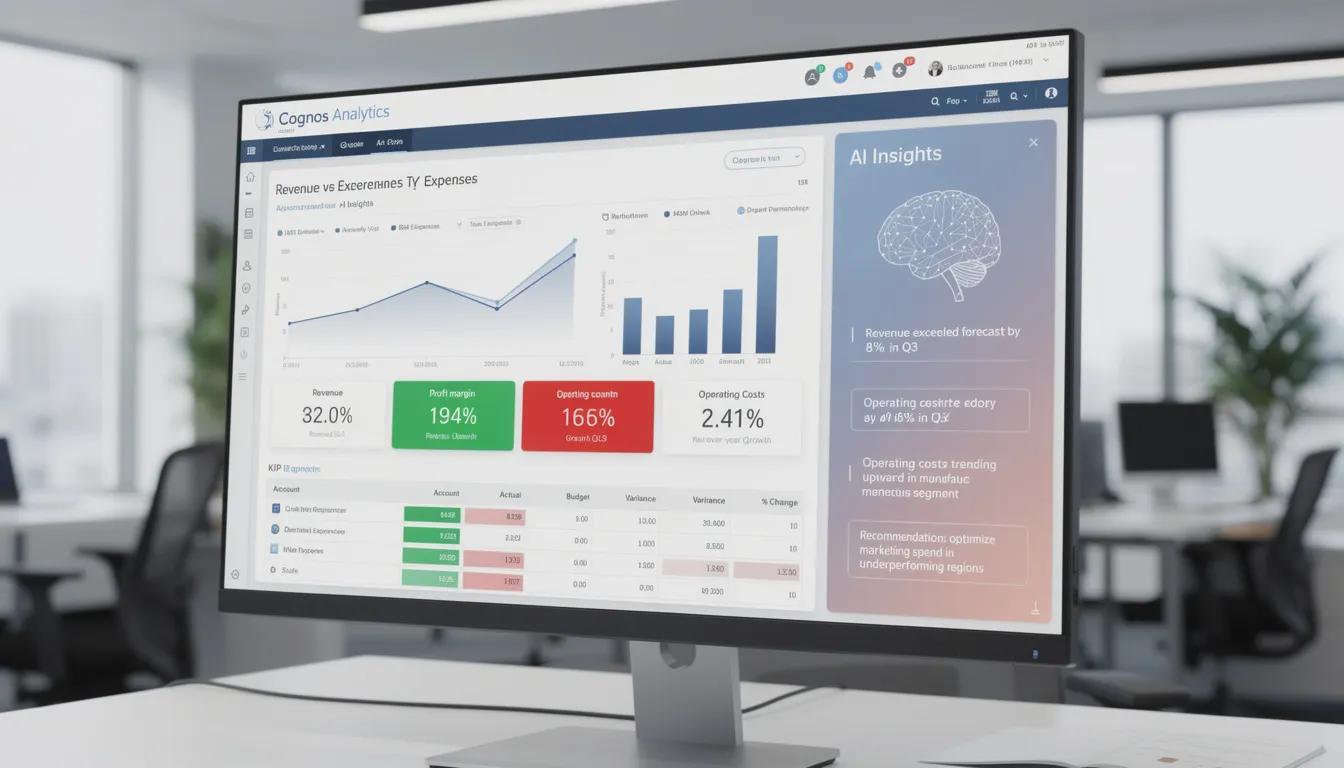
Features: AI-powered business intelligence integrates Watson capabilities for natural language querying, automated insights, and intelligent data preparation. Full-stack architecture handles data preparation through advanced visualization.
IBM India Operations: Significant presence across major cities with cloud and on-premise deployment options. Local cloud infrastructure through IBM Cloud India Region addresses data residency requirements.
Investment Requirements: Enterprise licensing typically ranges ₹5-15 lakhs annually depending on user count and capabilities. Implementation projects commonly require ₹20-50 lakhs.
Use Cases: Large Indian enterprises requiring comprehensive BI solutions with strict security requirements. Powers approximately 40% of India’s top 100 banks’ regulatory reporting per Forrester analysis.
Industry Expert Review: Cognos receives praise for enterprise-grade security and AI assistant capabilities enabling natural language interaction with data. HCL Technologies deploys Cognos for predictive maintenance in manufacturing clients. Primary challenges include complex setup requirements and significant infrastructure investments.
Oracle Analytics Cloud
Features: Comprehensive cloud-based analytics platform delivers machine learning integration, data visualization, and self-service analytics. Strong data integration capabilities connect Oracle databases, cloud applications, and third-party sources.
Oracle India Support: Established presence with local cloud infrastructure availability through Oracle Cloud Infrastructure India regions. Strong consulting ecosystem for implementation support.
Pricing Structure: Cloud subscription model with usage-based components. Enterprise deployments typically range ₹4-12 lakhs annually plus infrastructure costs.
Target Market: Large enterprises with existing Oracle ecosystem investments in ERP, HCM, or database technologies. Capgemini India integrates Oracle Analytics for ERP analytics serving manufacturing clients.
Professional Assessment: Oracle Analytics excels for organizations already invested in Oracle technologies, offering seamless integration with existing investments. Limitations include vendor lock-in concerns and premium pricing for non-Oracle-centric organizations.
Zoho Analytics
Features: Self-service BI platform provides drag-and-drop interface, AI-powered insights through Zia assistant, and extensive integration capabilities. Data preparation tools handle data cleaning and transformation without coding.
Indian Company Advantage: Chennai-based development ensures excellent local support, with product roadmap reflecting Indian market requirements. Customer service operates in IST with Hindi language support.
Competitive Pricing: Standard plan at ₹1,740/month for 2 users; Professional at ₹5,625/month for 5 users; Enterprise at ₹29,400/month for 50 users. Significantly more affordable than international competitors for Indian SMEs.
Integration Strengths: Seamless connectivity with Zoho ecosystem (CRM, Books, People) plus 500+ third-party application connectors including Tally, Shopify, and Salesforce.
Expert Review: Industry analysts highlight Zoho Analytics as offering best data analytics value for Indian small businesses and startups. User reviews on G2 (4.3/5) praise user-friendly interface and responsive customer support. Limitations include reduced advanced analytics capabilities compared to enterprise platforms and occasional performance constraints with very large datasets.
Sisense
Features: Simplifies complex data analytics through In-Chip technology enabling analysis of large datasets without extensive data preparation. Embedded analytics capabilities allow integration within existing applications.
Indian Market Approach: Partner-driven sales and implementation model with certified consultants in major cities. Cloud deployment options through AWS and Azure reduce infrastructure requirements.
Pricing Considerations: Mid-market positioning with scalable licensing typically ranging ₹3-8 lakhs annually for departmental deployments.
Technical Strengths: Handles analyze large datasets and unstructured data without performance degradation common in competing platforms.
Industry Expert Evaluation: Tiger Analytics customizes Sisense for customer insights serving 75+ Fortune 500 clients. Platform receives praise for handling complex datasets without requiring dedicated data engineering resources. Primary limitation involves smaller local partner ecosystem compared to major vendors.
Alteryx
Features: Data preparation and advanced analytics platform targets business analysts requiring data wrangling, blending, and predictive analytics without programming. Workflow automation reduces data manipulation time by up to 80%.
Indian Availability: Partner network provides sales and implementation support. Cloud deployment through Alteryx Cloud simplifies infrastructure requirements.
Investment Requirements: Premium pricing with Designer licenses starting approximately ₹4 lakhs annually. Server capabilities for enterprise deployment add significant costs.
User Profile: Data analysts and citizen data scientists in Indian corporations seeking to perform data analysis without IT dependency. LatentView Analytics leverages Alteryx for financial data blending.
Professional Review: Alteryx receives strong reviews for transforming analysts’ productivity, with 25% year-over-year adoption growth in Indian fintech for fraud detection applications. Learning curve and premium pricing represent primary adoption barriers for smaller organizations.
TIBCO Spotfire
Features: Advanced analytics platform delivers real-time analytics capabilities with streaming data support, predictive modeling, and geospatial analysis. Strong data exploration capabilities for operational and strategic decisions.
Indian Market Presence: Enterprise sales through local partners and distributors in major business centers. Implementation partners serve manufacturing, energy, and financial services sectors.
Cost Structure: Enterprise-level investment with licensing typically exceeding ₹8 lakhs annually for departmental deployments.
Industry Applications: Manufacturing analytics for quality control and predictive maintenance, energy sector operational optimization, and financial services risk analytics represent primary Indian use cases.
Expert Assessment: Spotfire excels for organizations requiring real-time analytics on streaming data sources. Implementation complexity and premium pricing restrict adoption to enterprises with sophisticated analytics requirements and dedicated data teams.
Comparison Table
| Software | Pricing Range (INR/year) | Deployment Options | Key Strengths | Ideal Business Size | Local Support Rating |
|---|---|---|---|---|---|
| Power BI | ₹10K-5L | Cloud, Hybrid | Excel integration, affordability | SME to Enterprise | ★★★★★ |
| Tableau | ₹42K-7L | Cloud, On-premise | Visualization excellence | Mid-market to Enterprise | ★★★★☆ |
| Qlik Sense | ₹36K-6L | Cloud, On-premise | Associative discovery | Mid-market to Enterprise | ★★★★☆ |
| SAS Analytics | ₹10L+ | Cloud, On-premise | Statistical rigor | Large Enterprise | ★★★★☆ |
| IBM Cognos | ₹5L-15L | Cloud, On-premise | AI-powered BI | Large Enterprise | ★★★★☆ |
| Oracle Analytics | ₹4L-12L | Cloud | Oracle ecosystem | Enterprise | ★★★★☆ |
| Zoho Analytics | ₹21K-3.5L | Cloud | Value, local support | Startup to Mid-market | ★★★★★ |
| Sisense | ₹3L-8L | Cloud | Large data handling | Mid-market | ★★★☆☆ |
| Alteryx | ₹4L+ | Cloud, Desktop | Data preparation | Mid-market to Enterprise | ★★★☆☆ |
| TIBCO Spotfire | ₹8L+ | Cloud, On-premise | Real-time streaming | Enterprise | ★★★☆☆ |
Synthesis: Budget-constrained SMEs should prioritize Power BI or Zoho Analytics for immediate value. Organizations with existing Microsoft investments gain maximum benefit from Power BI integration. Enterprises requiring advanced statistical analysis should consider SAS, while those needing real-time streaming analytics should evaluate Spotfire. For Oracle-centric organizations, Oracle Analytics Cloud provides seamless ecosystem integration.
Common Challenges and Implementation Solutions for Indian Businesses
Indian organizations face distinct obstacles when implementing analytics software, from legacy data infrastructure to skill availability. Understanding these challenges enables proactive mitigation strategies.
Data Quality and Integration Challenges
Managing data from multiple sources—including legacy systems common in Indian enterprises—creates significant data preparation burdens. Organizations typically spend 60-80% of project time on data cleaning and integration rather than analysis.
Solutions:
- Implement phased data integration starting with highest-value sources
- Establish data governance frameworks before analytics deployment
- Leverage modern analytics tools with built-in data preparation capabilities
- Consider master data management investments for enterprise deployments
Successful implementations demonstrate measurable improvement: Wipro achieved 25% inventory cost reduction for a retail client by systematically addressing data quality before deploying Power BI analytics on 1TB datasets.
Skills Gap and Training Requirements
India maintains approximately 500,000+ analytics professionals, yet this represents only 3% of global data science talent despite massive market demand. The resulting skills shortage creates 20-30% project delays according to Nasscom assessments.
Solutions:
- Invest in vendor certification programs through local training centers
- Partner with universities offering analytics curricula for talent pipeline
- Deploy platforms with strong self-service capabilities reducing technical expertise requirements
- Consider managed analytics services for initial implementations while building internal capabilities
ROI calculations for training investments typically show positive returns within 6-12 months through reduced implementation timelines and improved platform utilization.
Cost Management and Budget Optimization
Managing software licensing, data infrastructure, and operational costs within Indian budget constraints requires strategic planning. Cloud adoption typically reduces total ownership costs by 30-50% compared to on-premises deployments.
Solutions:
- Negotiate multi-year agreements for volume discounts
- Start with departmental pilots before enterprise rollouts
- Leverage freemium tiers (Power BI Desktop, Google Data Studio) for initial exploration
- Consider consumption-based pricing for variable workloads
Tips for maximizing value include right-sizing user licenses (many organizations over-provision expensive creator licenses when viewer licenses suffice), leveraging included data storage before purchasing additional capacity, and consolidating analytics platforms to reduce integration complexity.
Conclusion and Next Steps
Selecting the right data analytics tools depends on organizational size, budget constraints, technical requirements, and growth objectives specific to Indian market conditions. Power BI and Zoho Analytics lead for SMEs prioritizing value and local support. Tableau and Qlik Sense serve mid-market organizations requiring advanced visualization and data exploration. SAS, IBM Cognos, and Oracle Analytics address enterprise requirements for sophisticated statistical analysis, AI integration, and ecosystem compatibility.
Immediate actionable steps:
- Assess current data infrastructure, identifying primary data sources and integration requirements
- Define analytics requirements through stakeholder interviews and use case prioritization
- Request vendor demonstrations focusing on Indian-specific capabilities and support
- Evaluate total cost of ownership including implementation, training, and ongoing maintenance
- Conduct pilot projects with 2-3 shortlisted platforms before enterprise commitment
Future considerations: Agentic AI integration will reshape BFSI analytics in 2026, while edge analytics for IoT deployments gains momentum in smart city implementations. Generative AI enables natural language querying, reducing technical barriers for business users. Evolving regulations under DPDP Act 2023 will increase compliance requirements, making vendor data governance capabilities increasingly critical.
Organizations should schedule consultations with top-ranked vendors (Power BI, Tableau, Zoho Analytics) based on their size and requirements. Most platforms offer 14-30 day trials enabling hands-on evaluation with actual business data before purchase decisions.
Frequently Asked Questions
Which data analytics software offers the best value for Indian SMEs? Zoho Analytics delivers exceptional value for Indian SMEs with pricing starting at ₹1,740/month, Chennai-based support operating in IST, and seamless integration with popular Indian accounting software. Microsoft Power BI Pro at ₹844/user/month offers strong alternative for organizations with Microsoft 365 investments.
What are the data localization requirements for analytics software in India? Under DPDP Act 2023 and RBI guidelines, sensitive personal data and certain financial information must remain within Indian borders. Analytics platforms must offer Indian data residency options—available through Azure India, AWS Mumbai, Oracle Cloud India, and domestic Zoho infrastructure.
How do implementation costs vary between on-premise and cloud deployments in India? Cloud deployments typically cost 30-50% less over 3-year periods, with initial implementations averaging ₹10-25 lakhs versus ₹25-60 lakhs for on-premises. Cloud eliminates hardware investments, reduces IT staffing requirements, and provides automatic updates.
Which vendors provide the best local support and training in Indian cities? Microsoft maintains the strongest local presence with 10,000+ certified partners across India. Zoho offers direct Chennai-based support with Hindi capabilities. Tableau and Qlik maintain training centers in Bangalore, Mumbai, and Delhi with certification programs.
What ROI can Indian businesses expect from analytics software investments? Properly implemented analytics typically delivers 5x ROI within 18-24 months. Specific gains include 25-30% reduction in inventory costs, 15-20% improvement in customer retention, and 40-60% faster reporting cycles. Tiger Analytics documented 18% churn reduction for PayPal through customer analytics.
How do Indian data protection regulations impact software selection decisions? Organizations must verify vendor compliance with DPDP Act 2023 requirements including consent management, data portability, and breach notification capabilities. Banking and insurance sectors face additional RBI and IRDAI guidelines requiring specific security certifications and audit capabilities.
Which analytics platforms integrate best with popular Indian ERP systems? Power BI and Zoho Analytics offer strongest integration with Tally and Zoho Books. Oracle Analytics Cloud provides seamless connectivity for Oracle ERP implementations. SAP Analytics Cloud integrates natively with SAP S/4HANA common in large Indian manufacturing enterprises.
What are the key success factors for analytics implementation in Indian businesses? Success factors include executive sponsorship, clearly defined use cases with measurable outcomes, data quality investments before platform deployment, phased implementation starting with high-value applications, and sustained investment in user training and adoption programs.