Introduction
Finding the best e learning software for your organization requires navigating a market that has exploded to over $315 billion globally, with projections reaching $645 billion by 2030. This guide delivers a comprehensive analysis of the top 10 e learning software platforms available in 2026, comparing learning management systems, elearning authoring tools, and online course platforms across critical evaluation criteria.
This resource covers enterprise LMS platforms, authoring tools for creating interactive content, and online learning platforms designed for scalable training programs. We exclude basic video conferencing tools and focus specifically on solutions that support course development, learner progress tracking, and measurable training outcomes. The target audience includes L&D professionals managing corporate training initiatives, HR managers overseeing employee training and compliance training, educational institutions seeking robust learning management systems LMS, and business owners building professional development programs for a global audience.
Direct answer: The top 10 e learning software platforms in 2026 are Thinkific (best for course creators), Coursera (best for accredited learning), Docebo (best AI-powered enterprise LMS), TalentLMS (best for mid-market compliance training), Udemy (best marketplace variety), Absorb LMS (best for Fortune 1000 integrations), Moodle (best open-source solution), Blackboard Learn (best for higher education), edX (best for university credentials), and Skilljar (best for customer education).
By the end of this guide, you will understand:
- Precise platform comparison criteria for selecting the right elearning authoring tool
- Transparent pricing insights across subscription tiers and enterprise models
- Proven implementation strategies that reduce adoption friction
- Realistic ROI expectations backed by industry case studies
- A systematic selection framework for matching platforms to organizational needs
Understanding E Learning Software
E learning software encompasses the digital tools and platforms that enable organizations to create, deliver, track, and optimize training materials and educational content at scale. These solutions have evolved from basic course hosting into sophisticated ecosystems powered by artificial intelligence, enabling personalized learning experiences that adapt in real-time to individual learner needs.
Effective e-learning software is categorized into Learning Management Systems (LMS) for administration and Authoring Tools for content creation. The e-learning tools of 2025 are categorized into Authoring Tools for content creation and LMS for delivery and tracking.
The relevance to modern organizations is substantial: 92% of Fortune 500 companies now utilize lms platforms for employee training, onboarding, compliance training, and ongoing skill development. Whether managing soft skills training for sales teams or technical skills certification for IT departments, elearning software provides the infrastructure for consistent, measurable, and scalable training programs.
Learning Management Systems (LMS)
Learning management systems serve as centralized platforms for delivering online courses, tracking learner progress, managing assessments, and generating analytics on training effectiveness. Modern LMS platforms handle everything from user enrollment and content organization to certification management and reporting.
The connection to effective e learning is foundational: without a robust management system, organizations cannot systematically monitor learner engagement, identify knowledge gaps, or demonstrate compliance to regulatory bodies. LMS platforms support SCORM and xAPI standards, enabling content interoperability and granular tracking of learner behaviors—including micro-interactions like video engagement patterns that predict completion likelihood.
Authoring Tools and Course Creation Platforms
Elearning authoring tools provide the capabilities to develop interactive courses, training modules, and engaging learning materials without requiring extensive technical skills. These range from drag-and-drop builders accessible to subject matter experts to advanced elearning authoring tools used by experienced instructional designers for immersive learning experiences.
The relationship between authoring tools and learning management systems is symbiotic: authoring software creates the elearning content while the LMS delivers and tracks it. Many platforms now integrate both capabilities, streamlining the entire training process from creation to deployment. Understanding this integration is essential before evaluating specific platform capabilities.
Key Features and Evaluation Criteria
Building on foundational concepts, selecting the best elearning software requires systematic evaluation across technical capabilities, scalability requirements, and financial considerations. The right platform aligns with both current training objectives and projected organizational growth.
Essential Platform Capabilities
SCORM compliance (Sharable Content Object Reference Model) ensures your elearning courses work across different management systems, protecting content investments if you change platforms. Mobile learning support is non-negotiable—70% of learning now occurs on mobile devices, making responsive design and dedicated mobile apps critical for learner engagement.
Analytics capabilities separate adequate platforms from exceptional ones. Basic tracking shows completion rates; advanced systems powered by artificial intelligence predict dropout risk, recommend personalized learning paths, and identify content performance patterns. Integration options via APIs and tools like Zapier determine how seamlessly the platform connects with existing HR systems, CRMs, and collaboration tools.
Scalability and Collaboration Features
Multi-user support with role-based permissions allows organizations to manage diverse training programs across departments, regions, and user types. Enterprise-grade security—including SSO integration, data encryption, and compliance with GDPR and SOC 2 standards—becomes essential as organizations scale beyond initial pilot programs.
Social learning features and collaborative tools enhance engagement through peer interaction, discussion forums, and knowledge sharing. These capabilities transform passive course consumption into active learning communities, directly impacting knowledge retention and application. Remote learning environments particularly benefit from features that enhance collaboration among geographically distributed teams.
Pricing Models and ROI Considerations
E learning software pricing typically follows three models: per-user subscription (ranging from free to $15+ per user monthly), flat-rate tiers (suitable for organizations with predictable user counts), and custom enterprise pricing (negotiated based on specific requirements). Implementation costs—including content migration, customization, and training—often equal or exceed first-year licensing fees.
ROI calculations should consider reduced travel costs for on the job training, decreased time-to-competency for new employees, improved compliance audit outcomes, and measurable productivity gains. TalentLMS clients report 4:1 training ROI through productivity improvements, while organizations using AI-powered platforms like Docebo document 35% improvements in content retention.
Key evaluation factors include total cost of ownership, scalability pricing thresholds, and hidden costs for premium features. With these criteria established, let’s examine how each leading platform performs.
Top 10 E Learning Software Platforms: Detailed Reviews
The following analysis applies the evaluation framework to 2026’s leading elearning software companies, incorporating G2 ratings, market share data, and implementation outcomes from verified case studies. As one L&D director noted in an eLearning Industry review: “The difference between adequate and exceptional platforms isn’t features—it’s how well those features align with your specific training culture and technical environment.”
Comprehensive Platform Comparison
Each platform serves distinct use cases—selecting the right fit depends on organizational size, primary training objectives, and technical capabilities.
| Platform | Target Audience | Key Features | Pricing Range | Best Use Case | Integration Capabilities |
|---|---|---|---|---|---|
| Thinkific | Course creators, solopreneurs | Drag-and-drop builder, membership sites, marketing tools | $36-149/mo | Monetizing online courses | Zapier, Mailchimp, Shopify |
| Coursera | Enterprises, individuals | University partnerships, accredited degrees | $9.99-$399/user/year | Accredited professional development | SSO, HRIS systems |
| Docebo | Large enterprises | AI personalization, auto-enrollment, gamification | Custom | Enterprise-wide skills transformation | SAP, Salesforce, Workday |
| TalentLMS | SMBs, mid-market | Intuitive interface, compliance automation | Free-$10+/user | Compliance training, quick deployment | 200+ integrations |
| Udemy | Individuals, corporate teams | 210K+ courses, lifetime access | $10-200/course | Diverse skill development | Basic LMS integration |
| Absorb LMS | Fortune 1000s | AI skills mapping, advanced analytics | Custom | Complex enterprise requirements | SAP, Oracle, deep API |
| Moodle | Schools, budget-conscious orgs | Open-source, 2,000+ plugins | Free (self-host) or $80+/mo | Maximum customization | Extensive via plugins |
| Blackboard Learn | Higher education, K-12 | Virtual classrooms, community features | Custom | Academic institutions | SIS, accessibility tools |
| edX | Professionals, enterprises | MIT/Harvard courses, micro-credentials | Free audit, $50+ certs | University-level credentials | Enterprise LMS |
| Skilljar | B2B companies | Customer education portals, omnichannel | Custom | Customer training, product adoption | CRM, support platforms |
| Data compiled from G2 ratings, vendor documentation, and industry analyst reports as of Q1 2026. |
Detailed Platform Reviews
Thinkific
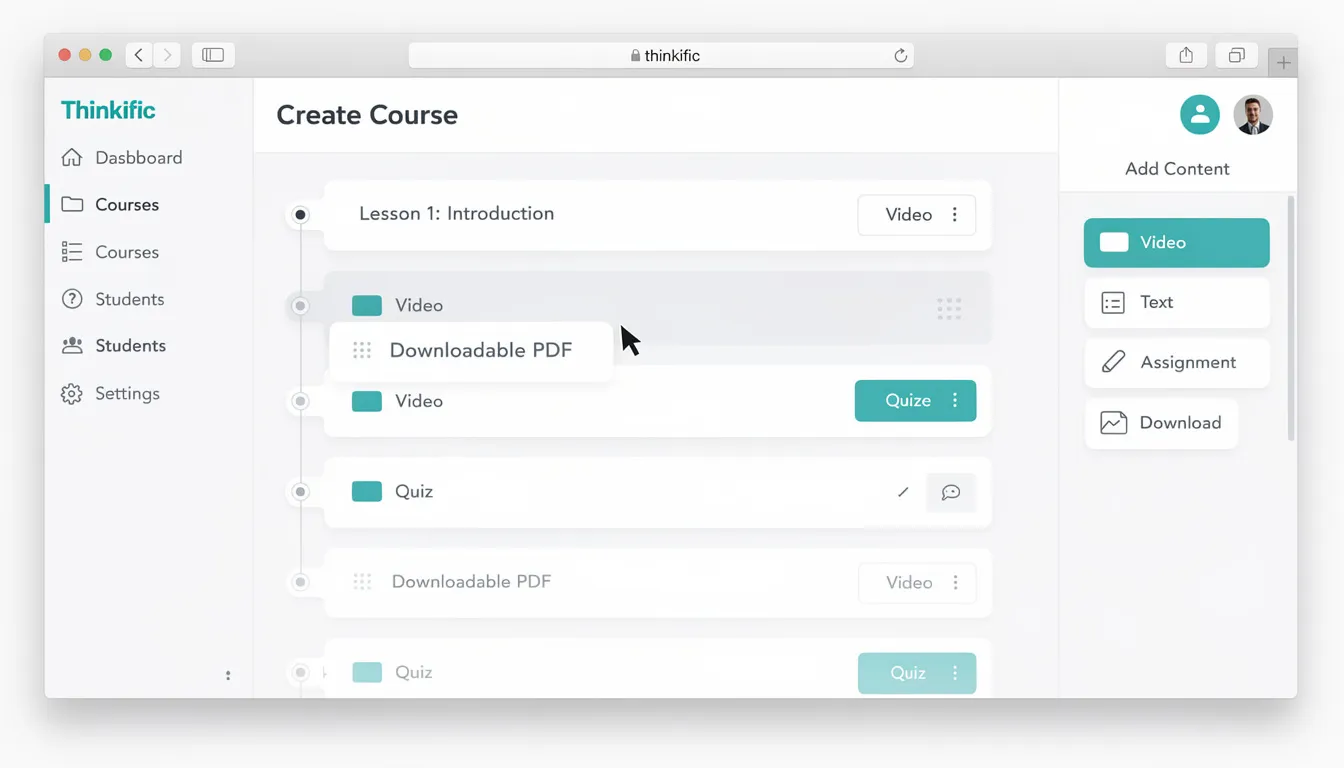
Thinkific (G2 Rating: 4.7/5) delivers the most comprehensive solution for entrepreneurs and small businesses seeking to create courses and monetize expertise. The user friendly platform eliminates the steep learning curve common in enterprise tools, with zero transaction fees on higher tiers protecting creator margins. A G2 reviewer reported: “Thinkific’s marketing tools scaled my revenue 300% in 18 months.” The platform excels for solopreneurs but lacks the advanced analytics and learner progress tracking required for corporate training at scale.
Coursera
Coursera (G2 Rating: 4.5/5) maintains partnerships with 300+ universities including Stanford and Yale, serving over 100 million learners with accredited online courses and degree programs. Enterprise plans at $399/user annually provide curated learning objectives for professional development, though the platform functions better for individual skill acquisition than structured organizational training programs. The diverse range of university-backed content makes it particularly valuable for employees pursuing credentials alongside practical skills.
Docebo
Docebo represents the premium tier of ai powered learning management, utilizing machine learning algorithms that analyze millions of data points to deliver personalized learning journeys. Rentokil Initial documented 25% higher completion rates after implementation, while a global bank achieved 28% faster skill acquisition across 50,000 employees. Custom pricing reflects enterprise-grade capabilities, and implementation requires dedicated project management resources. Industry experts at Forrester consistently rank Docebo among the top elearning software for organizations prioritizing skills transformation.
TalentLMS
TalentLMS (G2 Rating: 4.6/5) captures 25% of the mid-market with an intuitive interface that enables rapid deployment—many organizations launch compliance training within days. The platform’s advanced reporting capabilities satisfy audit requirements while maintaining accessibility for administrators without technical backgrounds. Free tiers accommodate small teams, scaling to custom enterprise arrangements. Mobile learning support ensures the training platform reaches distributed workforces effectively.

Udemy
Udemy (G2 Rating: 4.5/5) offers unmatched course variety with 210,000+ titles covering everything from web development to sales training. The pay-per-course model provides flexibility, though 50-75% revenue shares limit instructor earnings. Udemy Business extends the platform for corporate training, though organizations should note that quality varies significantly across the open marketplace. Lifetime access appeals to self-directed learners pursuing professional development at their own pace.
Absorb LMS
Absorb LMS (G2 Rating: 4.6/5) specializes in complex enterprise environments requiring deep integration with SAP, Oracle, and legacy systems. AI skills mapping helps organizations anticipate future talent needs, while 99% uptime SLAs satisfy risk-averse enterprises. Custom pricing reflects the platform’s positioning for Fortune 1000 organizations with sophisticated requirements. One industry analyst noted: “Absorb’s edge lies in skills ontologies that prepare organizations for 2027 job market shifts.”
Moodle
Moodle powers 25% of the global LMS market as the leading open-source solution, offering zero licensing costs for self-hosted deployments. The 2,000+ plugin ecosystem enables extensive customization, though successful implementation demands IT expertise—organizations without technical teams face 20-30% higher abandonment rates. Cloud hosting options starting at $80/monthly reduce technical barriers while maintaining flexibility. Educational institutions particularly benefit from Moodle’s academic-focused feature set.
Blackboard Learn
Blackboard Learn dominates higher education with dynamic virtual classroom capabilities and robust community features. Recent AI tool additions support adaptive learning experiences, though the platform’s complexity creates a steep learning curve for administrators transitioning from simpler systems. K-12 institutions praise the accessibility features, while enterprise deployments remain less common due to academic-oriented design assumptions.
edX
edX (G2 Rating: 4.5/5) extends the MOOC model through micro-credentials that stack toward full degrees from institutions like MIT and Harvard. Free course audits democratize access, while verified certificates ($50+) provide formal recognition. Enterprise offerings enable organizations to blend prestigious educational content with internal training materials, creating comprehensive elearning development programs.
Skilljar
Skilljar specializes in customer education, helping B2B companies scale product training and support. High NPS scores reflect the platform’s focus on external audiences rather than employee training. Omnichannel delivery ensures customers access training across mobile devices, web, and embedded experiences. One case study documented 90% self-serve adoption following Skilljar implementation, dramatically reducing support costs.
Common Implementation Challenges and Solutions
Understanding platform capabilities is essential, but successful deployment depends on navigating implementation obstacles that derail even well-chosen solutions. Proactive planning for these challenges protects training investments and accelerates time-to-value.
User Adoption and Change Management
Clear, actionable solution: Launch pilot programs with enthusiastic early adopters before organization-wide rollout, then leverage their success stories to build momentum. Create change management plans that communicate specific benefits to each user group—managers see tracking capabilities, employees see career development opportunities, and executives see compliance risk reduction.
Resistance often stems from unclear value propositions rather than platform limitations. Organizations that invest in pre-launch communication and ongoing champion programs report 40% higher adoption rates. Consider gamification features available in platforms like Docebo to incentivize initial engagement during the critical first 90 days.
Technical Integration Difficulties
Clear, actionable solution: Map all required integrations before vendor selection, then verify API compatibility through proof-of-concept testing rather than vendor claims. Budget 15-20% of implementation costs for unexpected integration work, and establish clear data ownership protocols before migration begins.
Only 55% of LMS implementations achieve full API harmony with existing systems. Organizations underestimate the complexity of connecting elearning tools with HRIS, CRM, and communication platforms. Platforms offering native integrations (like TalentLMS with 200+ connectors) reduce technical risk compared to custom API development.
Content Creation and Quality Control
Clear, actionable solution: Establish content standards and review processes before authoring begins, designating subject matter experts for accuracy verification and instructional designers for learner engagement optimization. Use built-in authoring tools to maintain consistency, and create templates that balance production efficiency with training effectiveness.
Quality control failures compound over time—poorly designed interactive modules frustrate learners and reduce completion rates. Organizations using advanced elearning authoring tools with built-in accessibility checking and mobile preview capabilities maintain higher content standards. Regular content audits ensure training materials remain current and aligned with evolving learning objectives.
Success in these areas creates the foundation for measurable training outcomes and sustained platform value.
Conclusion and Next Steps
Selecting the right e learning software requires matching organizational requirements with platform capabilities across usability, scalability, integration, and total cost of ownership. The best elearning software for one organization may underperform in another context—systematic evaluation using the frameworks in this guide leads to confident decisions.
Immediate action steps:
- Assess current training needs by documenting existing programs, user volumes, compliance requirements, and integration dependencies
- Request demonstrations from your top 3 platform candidates, providing realistic use cases for evaluation
- Launch a pilot program with a contained user group to validate assumptions before enterprise commitment
- Plan full deployment with explicit success metrics tied to business outcomes
For deeper exploration, consider related topics including LMS implementation best practices for managing the technical transition, training content creation strategies using powerful authoring tools, and frameworks for measuring e learning ROI across different program types.
The elearning market continues evolving rapidly—platforms incorporating AI-powered personalization, immersive learning experiences through VR/AR, and skills-based ontologies will define competitive advantage through 2030. Organizations that invest in scalable, adaptable solutions position themselves to leverage these advances as they mature.
Frequently Asked Questions
What is the typical cost range for enterprise e learning software? Enterprise LMS pricing ranges from $3-15+ per user monthly for mid-market solutions like TalentLMS to custom enterprise agreements for platforms like Docebo and Absorb. Implementation costs often equal first-year licensing—budget 150-200% of quoted subscription fees for realistic total cost planning.
How long does LMS implementation typically take? Simple deployments on user friendly platforms like TalentLMS can launch within 2-4 weeks. Enterprise implementations with complex integrations, content migration, and custom configurations typically require 3-6 months. EducateMe demonstrated that AI-assisted platforms can reduce development time by 70% for straightforward use cases.
What user capacity should I plan for when selecting a platform? Plan for 150% of current user counts to accommodate growth without mid-contract renegotiation. Most platforms tier pricing at common thresholds (100, 500, 1000, 5000 users)—understand these break points before committing to avoid unexpected cost jumps.
How important is mobile compatibility for modern elearning? Mobile learning is essential—70% of learning now occurs on mobile devices. Evaluate both responsive web design and dedicated mobile apps, as learning experience quality varies significantly. Platforms like TalentLMS prioritize mobile-first design for distributed workforce training.
What integration requirements should I prioritize? Priority integrations include HRIS for automated enrollment, SSO for security and user experience, and communication tools for notification and completion alerts. Verify native integration availability versus custom API development requirements, as integration complexity drives significant implementation costs.
How do I migrate existing training content to a new platform? SCORM-compliant content migrates most easily between learning management systems lms. Budget 20-30% of implementation time for content migration, including reformatting interactive content and verifying functionality. Some platforms offer migration assistance—negotiate this support during vendor selection.
What security features should enterprise organizations require? Minimum requirements include SOC 2 compliance, SSO integration, data encryption at rest and in transit, role-based access controls, and GDPR compliance for organizations with EU operations. Platform security audits and penetration testing documentation should be available upon request.
How do I measure e learning ROI effectively? Track leading indicators (completion rates, assessment scores, monitoring learner progress) and lagging indicators (productivity metrics, compliance audit outcomes, employee retention). Platforms with advanced analytics simplify measurement—Docebo users report 35% retention improvements through AI-driven personalization features.
Additional Resources
Implementation Tools:
- E learning software comparison checklist covering 50+ evaluation criteria
- Implementation timeline template with milestone tracking
- ROI calculation worksheet incorporating direct and indirect training costs
Research and Analysis:
- G2 Grid Reports for Learning Management Systems (updated quarterly)
- Forrester Wave analysis of enterprise learning platforms
- eLearning Industry annual state of corporate training report
Professional Development:
- Instructional design certification programs for L&D teams
- Change management frameworks for technology adoption
- Training content development best practices from experienced instructional designers
Disclaimer: Pricing and feature information reflects publicly available data as of Q1 2026. Enterprise pricing requires direct vendor consultation, and platform capabilities may vary based on subscription tier and custom configurations. Organizations should verify current specifications before purchase decisions.