India’s ERP market has emerged as one of the fastest-growing enterprise software segments globally, with the Indian ERP market projected to exceed $1.2 billion by 2026. Businesses seeking reliable erp software companies in India now have more options than ever—from established global giants to innovative homegrown erp solution providers reshaping how Indian businesses manage their core business processes.
This guide covers established Indian erp software firms, multinational companies with strong India presence, and emerging cloud-based erp solutions disrupting traditional enterprise resource planning deployments. Whether you’re a CTO evaluating erp software solutions for a manufacturing conglomerate, an IT manager at a medium sized enterprise, or a business owner seeking affordable business management software, this analysis addresses your specific evaluation needs.
Direct answer for quick reference: The top 5 erp software companies in India for 2026 are SAP India (enterprise leader with 25% market share), Tally Solutions (dominant in small businesses with 40% SMB penetration), Oracle India (cloud erp innovation leader), Microsoft India (unified erp system with Dynamics 365), and Ramco Systems (homegrown enterprise resource planning software specialist).
By reading this complete guide, you will gain:
- Detailed profiles of 15 leading erp software companies operating in India
- Market analysis with growth projections and industry trends through 2026
- Selection criteria tailored to different business sizes and various industries
- Implementation insights from industry experts and case studies
- Comprehensive cost considerations and ROI frameworks
Understanding ERP Software Companies in India
An erp software company differs fundamentally from an erp software product—the company encompasses the organization providing development, implementation, customization, training, and ongoing support, while the product represents the actual erp system deployed. This distinction matters because successful erp implementation depends as much on the erp vendor’s capabilities as on the software’s features.
Indian ERP Market Overview
The Indian ERP market has grown at a compound annual rate of 15% since 2020, driven by mandatory GST compliance requirements, accelerated digital transformation initiatives, and the sustained shift toward remote work environments. Industry analysts from Gartner and IDC project this growth trajectory to continue through 2028, with cloud based erp solutions capturing over 70% of new deployments.
Three factors fuel this expansion: first, the Make in India initiative has pushed manufacturing businesses toward integrated enterprise resource planning for operational efficiency; second, GST’s unified tax framework made erp software essential for compliance across multiple business processes; third, the pandemic permanently shifted attitudes toward cloud based erp software and remote accessibility.
According to G2’s 2025 market analysis, “India represents one of the most dynamic ERP adoption markets globally, with unique requirements around localization, compliance, and cost sensitivity that shape vendor strategies significantly.”
Types of ERP Companies in India
Homegrown Indian ERP companies bring deep local market expertise, understanding regulatory nuances, and providing rupee-based pricing with localized support. Companies like Ramco ERP and Tally Solutions have built products specifically for Indian businesses, incorporating GST compliance, multi-language interfaces, and features aligned with local business operations.
Global companies with strong India operations include SAP, Oracle, and Microsoft, which have invested heavily in India-specific localization, established local partnerships, and adapted their erp solutions for the Indian regulatory environment. These organizations offer robust enterprise resource planning software with global best practices adapted for local needs.
Emerging startups and cloud-first providers represent the disruptive segment—companies like Zoho ERP and ERPNext offering innovative, affordable cloud based erp solutions that challenge traditional deployment models with lower upfront costs and faster implementation timelines.
Understanding these categories helps frame expectations around pricing, support, customization capabilities, and long-term partnership dynamics as we examine specific companies.
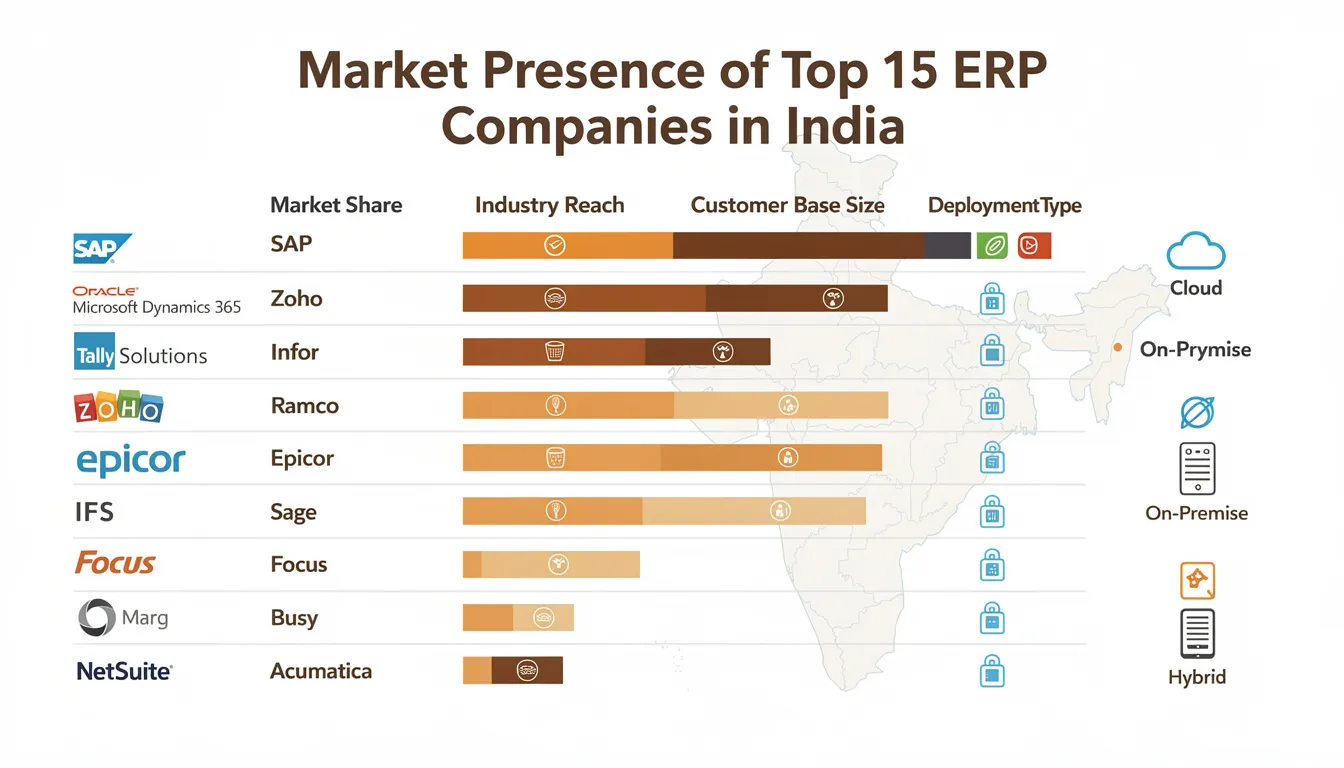
Top 15 ERP Software Companies in India
Building on this market understanding, let’s examine the 15 most significant erp software companies serving Indian businesses, organized by their market positioning and origin.
Company selection considered multiple factors: market share and revenue in India, client base diversity, implementation track record, product innovation, support infrastructure, and verified customer reviews from platforms like G2, Clutch, and Gartner Peer Insights.
Leading Indian ERP Companies
1. Ramco Systems
Ramco ERP stands as India’s most prominent homegrown enterprise resource planning company, headquartered in Chennai with over three decades of erp software development experience. Their flagship Ramco ERP on Cloud serves manufacturing businesses, logistics companies, and aviation enterprises across 35+ countries.
Ramco’s strength lies in vertical-specific solutions—their Aviation Suite powers airlines globally, while their logistics module handles complex supply chain management requirements. The mobile-first architecture enables real-time asset management and human resource management from any location.
Clutch reviews highlight Ramco’s implementation methodology: “Ramco’s understanding of Indian manufacturing complexities saved us six months of customization compared to Western vendors we evaluated.”
2. Tally Solutions
TallyPrime dominates India’s small businesses segment, with over 7 million users making it the most widely deployed erp software in India by installation count. From its Bangalore headquarters, Tally has evolved from basic accounting software into a comprehensive business management software platform.
Key features include seamless GST compliance, inventory management, financial management, and cash flow management—all designed for businesses without dedicated IT teams. Starting at approximately INR 18,000 for perpetual licensing, TallyPrime offers exceptional value for small businesses prioritizing simplicity and compliance over advanced analytics.
G2 reviewer feedback: “Tally’s simplicity wins for 80% of Indian SMEs—we implemented in three days without external consultants.”
3. Logic Information Systems (LOGIC ERP)
LOGIC ERP serves manufacturing businesses and medium sized enterprises from Ahmedabad, specializing in sectors like textiles, chemicals, and engineering. Their comprehensive modules cover production planning, quality management, vendor management, and business intelligence.
The company differentiates through industry-specific templates that reduce implementation timelines from months to weeks for clients in their focus sectors. On-site support availability across major Indian cities provides reassurance for businesses requiring hands-on assistance.
4. Marg ERP
Marg ERP targets retail, pharmaceutical distribution, and medium sized businesses requiring GST-ready erp software with minimal complexity. Their product suite addresses inventory management, billing, and customer relationship management needs for businesses processing high transaction volumes.
With pricing starting under INR 20,000 annually, Marg delivers essential erp tools without enterprise-level costs, making it accessible for businesses beginning their digital transformation journey.
5. TCS (Tata Consultancy Services)
While primarily known as an IT services giant, TCS offers proprietary erp solutions and serves as a premier implementation partner for global platforms. Their TCS iON suite provides cloud based erp solutions designed specifically for medium enterprises and educational institutions.
TCS’s advantage lies in combining erp software with broader digital transformation services, offering clients integrated approaches spanning business automation, machine learning integration, and advanced analytics implementation.
Global Companies with Strong India Presence
6. SAP India
SAP ERP commands approximately 25% of India’s enterprise erp software market, dominating large manufacturing, retail, and services organizations. SAP Business One targets medium sized enterprises, while SAP S/4HANA serves enterprise clients requiring real-time business intelligence across global operations.
SAP’s India operations include development centers, training academies, and an extensive partner network providing implementation and support. The platform excels in financial management, supply chain management, and human capital management with deep customization capabilities.
Implementation timelines typically span 6-12 months with costs ranging from tens of lakhs to crores depending on scope—a significant investment delivering comprehensive business operations integration.
Industry expert review from Gartner Peer Insights: “SAP’s ecosystem in India is unmatched—finding implementation partners, certified consultants, and integration specialists is straightforward compared to alternatives.”
7. Oracle India
Oracle ERP Cloud and NetSuite represent Oracle’s dual strategy—enterprise cloud erp for large organizations and NetSuite for growth-focused medium sized businesses. Oracle’s Bangalore development center drives innovation in artificial intelligence features and autonomous capabilities.
Oracle excels in project management, professional services automation, and complex supply chain scenarios. Their cloud-native architecture enables rapid deployment compared to on premise solution alternatives, with subscription pricing providing predictable operational costs.
8. Microsoft India
Microsoft Dynamics 365 offers unified erp system and customer relationship management capabilities, integrating natively with Microsoft 365 productivity tools millions of Indian businesses already use. This seamless integration reduces training requirements and accelerates user adoption.
Dynamics 365 modules span financial management, supply chain management, human resource management, and customer relationship management—all accessible through familiar interfaces. Pricing starts around $100/user/month, positioning it for medium to large enterprises prioritizing Microsoft ecosystem compatibility.
Dynamics 365 users on G2 rate the platform 4.5+ stars, with reviewers noting: “The integration with existing systems like Office 365 meant our team was productive within weeks, not months.”
9. NetSuite India
NetSuite pioneered cloud based erp solutions and maintains leadership in cloud-native enterprise resource planning for growing businesses. Their unified platform eliminates integration complexity between financial management, CRM, and e-commerce functions.
NetSuite’s strength lies in scalability—businesses can start with core financials and expand to comprehensive modules as requirements evolve. This flexibility particularly benefits medium sized enterprises with ambitious growth trajectories.
10. Infor India
Infor delivers industry-specific erp software for manufacturing businesses, healthcare, hospitality, and distribution sectors. Their CloudSuite offerings incorporate machine learning and advanced analytics tailored to vertical requirements.
Infor’s India presence includes implementation teams and support infrastructure focused on manufacturing excellence, making it a strong contender for automotive, aerospace, and industrial clients.
Emerging and Specialized ERP Providers
11. Zoho ERP (Zoho One)
Zoho ERP provides modular, affordable erp software solutions from its Chennai headquarters, offering an integrated suite of 45+ applications covering financial management, inventory management, project management, and customer relationship functions.
With pricing starting below $50/user/month, Zoho democratizes erp access for small businesses previously priced out of enterprise resource planning. The platform’s user-friendly interface requires minimal training, enabling rapid deployment without extensive IT support.
12. ERPNext
ERPNext represents the leading open-source erp solution, offering 80% cost savings compared to proprietary alternatives for businesses willing to invest in customization. The platform covers manufacturing, retail, services, and educational sectors with comprehensive modules.
Community-driven development ensures continuous improvement, while commercial support options address businesses requiring guaranteed service levels. ERPNext particularly suits technology-comfortable organizations seeking maximum flexibility.
13. Odoo India
Odoo’s modular architecture enables businesses to adopt specific erp tools—inventory management, accounting, CRM—without committing to full suite deployment. The open-source core with commercial modules creates a flexible solutions approach.
Growing Indian businesses appreciate Odoo’s ability to start small and scale organically, adding capabilities as business operations expand without disruptive migrations.
14. Deskera
Deskera offers cloud based erp software designed specifically for medium sized businesses seeking simplicity without sacrificing capability. Their integrated platform covers accounting, CRM, human resource management, and project management with AI-powered insights.
Singapore-headquartered with strong India presence, Deskera emphasizes ease of use and rapid implementation—typically measured in weeks rather than months.
15. Epicor India
Epicor ERP targets manufacturing businesses, distribution companies, and retail organizations requiring scalable erp software with comprehensive support infrastructure. Their focus on specific verticals enables deep functionality aligned with industry requirements.
Epicor’s recent cloud investments position the platform for businesses transitioning from legacy on premise solution deployments to modern cloud based erp architectures.
Detailed Analysis and Implementation Considerations
With company profiles established, practical implementation considerations become paramount for translating this knowledge into successful erp implementation decisions.
Company Selection Process
Choosing the right erp provider requires systematic evaluation balancing technical capabilities, organizational fit, and long-term partnership viability.
- Define business requirements and budget constraints: Document core business processes requiring automation, compliance requirements, user counts, and realistic budget ranges including implementation, training, and ongoing support costs.
- Assess company credibility and market reputation: Verify client references in your industry, check financial stability for long-term viability, and review ratings on platforms like G2, Clutch, and Gartner Peer Insights.
- Evaluate technical capabilities and support infrastructure: Confirm local support availability, escalation procedures, data migration capabilities, and integration options with existing systems.
- Request demos and proof-of-concept implementations: Insist on demonstrations using your actual business scenarios rather than generic presentations. Evaluate user interface intuitiveness and reporting capabilities.
- Check references and conduct due diligence: Speak directly with current clients about implementation experience, post-deployment support quality, and any unexpected challenges encountered.
Comparative Analysis Framework
| Evaluation Criteria | Indian Companies | Global Companies | Emerging Players |
|---|---|---|---|
| Local Compliance | Excellent—built-in GST, TDS, localization | Good—requires configuration | Variable—depends on maturity |
| Implementation Cost | Moderate (₹5-50 lakhs typical) | High (₹50 lakhs to crores) | Low (₹2-15 lakhs) |
| Customization Capability | High with local understanding | Very High with extensive resources | Moderate—template-driven |
| Support Quality | Excellent with local presence | Good with tiered structures | Variable by provider |
| Scalability | Regional focus | Global capabilities | Growing infrastructure |
| Implementation Timeline | 2-6 months | 6-18 months | 1-3 months |
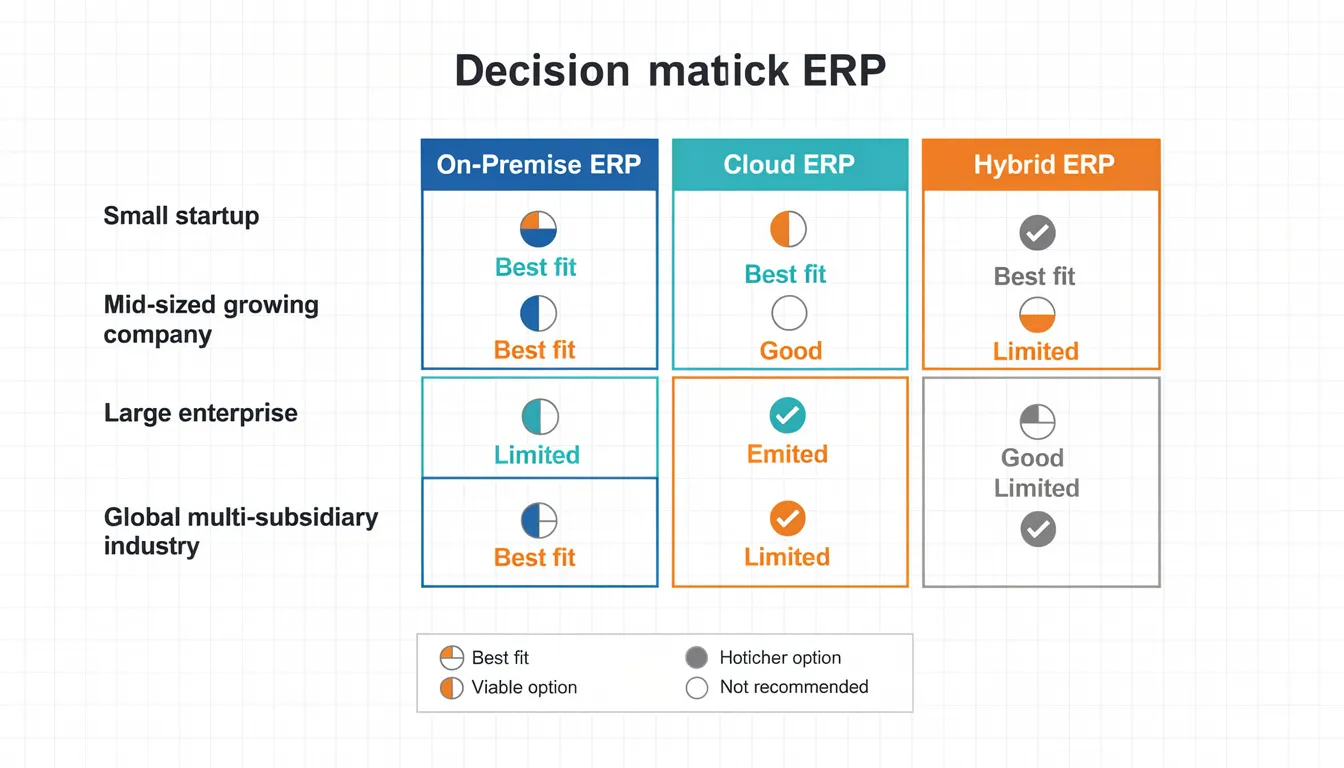
This framework helps businesses match their priorities with erp solution provider strengths. Organizations prioritizing rapid deployment with tight budgets should weight emerging players heavily, while enterprises requiring global scalability and deep customization should evaluate global companies despite higher costs.
The decision ultimately balances immediate requirements against future growth trajectories—selecting an erp vendor capable of supporting evolution from current state to strategic vision.
Common Challenges and Solutions in ERP Company Selection
Even with thorough evaluation, common pitfalls threaten erp software selection success. Understanding these challenges before vendor selection enables preventive measures.
Vendor Lock-in Concerns
Evaluate data portability and migration capabilities before commitment. Request documentation of data export formats, API availability, and contractual terms around data ownership. Negotiate contract terms explicitly protecting against excessive switching costs—including provisions for reasonable data extraction assistance if the relationship ends.
Organizations selecting proprietary platforms should factor potential future migration costs into total cost of ownership calculations rather than evaluating only initial deployment expenses.
Implementation Timeline Delays
Choose companies with proven track records of on-time delivery in your industry and business size category. Request references specifically for timeline performance—not just overall satisfaction. Establish clear milestones with meaningful consequences for delays in contracts, ensuring accountability throughout the implementation process.
Industry data suggests 20-25% of erp implementations experience significant delays, often due to underestimated data migration complexity or insufficient change management investment.
Post-Implementation Support Issues
Verify support infrastructure and escalation procedures before selection rather than discovering limitations after deployment. Consider companies with 24/7 support and local presence in India—particularly if your business operations span multiple time zones or require after-hours coverage.
Confirm support team expertise levels, response time commitments, and paths for escalating complex issues beyond front-line technicians. The best erp software becomes problematic without responsive, knowledgeable support.
Cost Overrun Management
Demand fixed-price contracts with clearly defined scope boundaries for implementation phases. Choose companies with transparent pricing and demonstrated cost estimation accuracy from reference clients. Build contingency budgets acknowledging that business process discovery during implementation often reveals additional requirements.
Successful erp implementation requires balancing comprehensive scoping upfront with realistic acknowledgment that some discoveries only emerge through detailed configuration work.
Conclusion and Next Steps
Selecting the right erp software company extends beyond comparing feature lists—it requires evaluating organizational fit, implementation capability, support infrastructure, and long-term partnership viability. India’s diverse erp landscape offers options for every business size and budget, from global enterprises like SAP and Oracle to innovative providers like Zoho and ERPNext delivering significant cost savings without sacrificing essential capabilities.
The best erp software for your organization depends on your specific requirements: small businesses prioritizing simplicity and affordability should evaluate Tally and Marg; medium sized enterprises seeking balanced capability and cost should explore Zoho, NetSuite, or Ramco; large enterprises requiring comprehensive customization should engage SAP, Oracle, or Microsoft Dynamics.
Take these immediate next steps:
- Create an RFP template incorporating your specific business processes, compliance requirements, and integration needs
- Shortlist 3-5 erp software companies matching your size, industry, and budget parameters
- Schedule demonstrations using your actual business scenarios rather than vendor-prepared examples
- Contact reference clients in similar industries to verify implementation and support experiences
- Develop evaluation scorecards enabling objective comparison across vendors
For deeper exploration, consider researching ERP implementation best practices to understand deployment methodologies, and post-deployment optimization strategies to maximize ROI from your selected erp solution.
Additional Resources
ERP Company Evaluation Checklist:
- [ ] Financial stability verification (3+ years profitability)
- [ ] India-specific compliance features (GST, TDS, e-invoicing)
- [ ] Local support infrastructure (offices, certified partners)
- [ ] Reference clients in your industry vertical
- [ ] Data portability and migration support
- [ ] Training and change management resources
- [ ] Scalability path for anticipated growth
- [ ] Integration capabilities with existing systems
- [ ] Security certifications and compliance documentation
Sample RFP Framework Elements:
- Business background and strategic objectives
- Current systems landscape and integration requirements
- Functional requirements by business process
- Technical requirements (cloud/on-premise, mobile access)
- Implementation timeline expectations
- Budget parameters and pricing format requirements
- Support and SLA requirements
- Vendor qualification criteria
Industry Research Resources:
- Gartner Magic Quadrant for Cloud ERP (annual publication)
- G2 Grid Reports for ERP Software
- Clutch.co Top ERP Companies in India
- IDC MarketScape for SaaS and Cloud-Enabled ERP
Disclaimer: This guide provides informational analysis based on publicly available information and industry research. Specific vendor capabilities, pricing, and availability may change. Conduct independent verification before making procurement decisions.